
on: ‘The Impact of Race: Theatre and Culture’ by Woodie King Jr.
notes from my first read, highlighting how Black theatrical legacies reflect a cultural dedication to access.
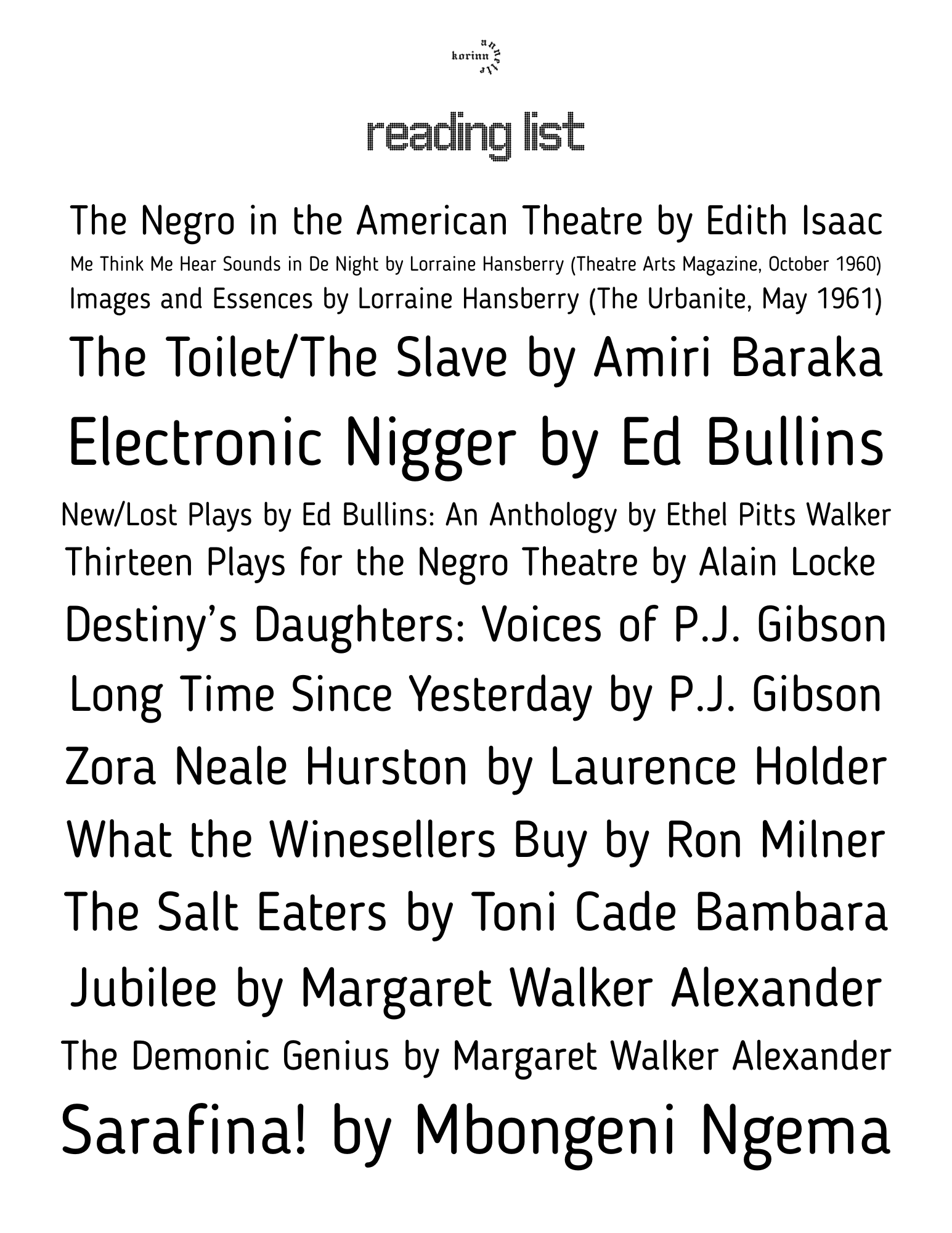
and, a reading list (scroll down).
“I am witness. I was there.” p 92
on Black business:
“Black businesses sustain themselves because they have a product that Black people need. Black artists create the spiritual and cultural nourishment Black people need.” p 14
“We must find “isms” again because our Blackness isn’t enough. Our Blackness is simply the surface of how we appear to ourselves and to others. We must have some sort of political direction. We must believe in something; we must have a sense of value beyond money.” p 22
“GHETTO ART & ENERGY”
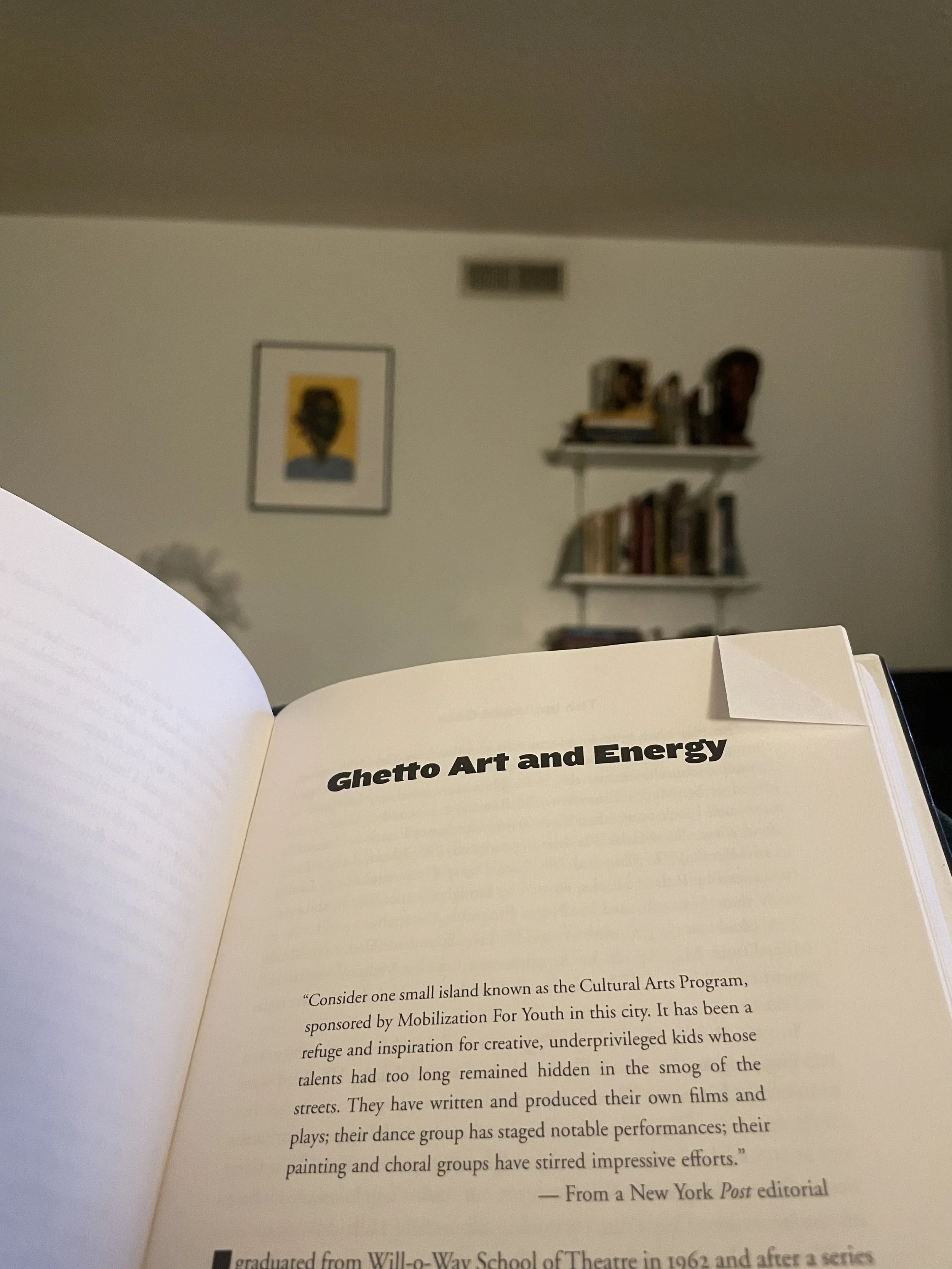
“That’s how it’s always been in this country: the new citizen, angry because it’s not the way he dreamed it would be, but come hell or high water he’s going to make it that way. Those are the fellows that revive our art, our nation’s self respect… (In the near future, Rap and Hiphop will be instrumental in defining the culture.)” p 36
youth theatre, street theatre, the Cultural Arts Program of Mobilization for Youth as a lesson in access:
King discusses the Cultural Arts Program of Mobilization For Youth (MFY) that began the summer of 1965, formed with the intention of giving “young people in the area a real chance at professional experience and training via the arts as they relate to everyday life.“ p36
“While mothers hung out of tenement windows and young boys lounged on fire escapes, many who’d never even seen a play before got their first taste of theatre that related to their lives. In fact, Dope! was so real to some members of the audience that they got up on stage to dance during a party scene and later hissed at the hero when he started to take a fix. They, you see, knew something about the hero’s life thata the hero didn’t know. And they wanted that young man to make the right decisions. An old woman junkie begged the hero not to take the drugs, telling him to look at her, see what dope had done to her. I was reminded of something Malraux wrote in Man’s Fate: “We hear our own voice with our throat, we hear voices of others with our ears.” p 36
on students in the program:
“We expect them to learn to communicate ideas and feelings, to learn to approach simple problems creatively, to understand that to accomplish worthwhile things often requires patience and persistence more than inspiration. We expect them to learn that the human body and the human voice are the vehicle and instrument of the spirit and intellect; the suppressed intellectual energy can be expressed creatively rather than physically. And we expect them to appreciate that the cultivated primary human instrument is capable of enormous power and subtle expression.” p37
“We wanted plays that could speak to ghetto audiences, that, the language of the ghetto would deal with issues meaningful and important to its people. We wanted plays that accurately said what the actors were really thinking as youngsters living in the ghetto.” p 37
“BREAKING THE RULES— EDUCATION ETHICS AND ETHNICITY”
advice for educators:
“The better artists take the human condition, recreate and shape it in a beautiful and artistic art, a beautifully realized, culturally diverse character, a brilliantly executed piece of choreography, a dance, a culturally diverse play … the unique way in which this art is given back is called ‘vision.’ I believe the better educators are also artists and visionaries. They take what a student brings and uses it to help shape that student into a piece of art.” p 72
““Cultural diversity” means absolutely nothing if the student doesn’t have a sense of his own culture. Breaking rules is extremely difficult when your education and Eurocentric institutions exist on rules.” p 72
“JAMES BROWN IN LIBERIA”
favorite chapter. phenomenal storytelling.
“THE AFRICAN-AMERICAN THEATRE OF TOMORROW”
“Karamu is the grand parent of the Black Theatre. It existed all by itself when our minds carried the possibility of something as remote as A Negro in the American Theatre. In 1947 when Edith Isaac wrote her historical book The Negro in the American Theatre, one third of it was about Karamu. It’s an institution that has been presenting plays with Black artists in leading roles since it’s inception. Those who passed through have gone on to some of the highest positions of leadership in the American Theatre, Hollywood Television and the motion picture industry. Karamu also sent those-who-passed-through into leadership positions in business, education and social science. Karamau is the boy scouts.” p 95
“Black institutions (or Black controlled institutions) are somewhat different. Many are so seriously underfunded they look for anything Black that can be booked into the institution and often get productions that turn Black audiences off…” p 102
“Starting in the mid-Eighties, a culturally accepted form of self criticism within Black arts circles (especially circles that worked within white institutions) was overwhelmingly endorsed by white institutions. These artists and thier productions toured constantly.” p 103
the part about BTN, AUDELCO as a lesson in access:
BTN’s inaugural Winona Lee Fletcher Award 1995 Recipients: Abena Joan Brown, Vinnette Carroll, Vivian Robinsosn, Ntozake Shange, Barbara Ann Teer, and Margaret Wilkerson p 105
Vivian Robinson founded AUDELCO:
“In her acceptance speech, Robinson talked about how she formed AUDELCO. In the early Seventies as she attended theatres, she noted very few Blacks attended. She began to form theatre parties to correct this situation. These theatre parties developed into an organization and on April 1, 1973, the Audience Development Committee, Inc., better known as AUDELCO, was founded.
Supported by theatregoers who were part of AUDELCO Theatre Parties, Vivian Robinson felt the need, additionally, to do something to encourage and honor Black artists. When Douglas Turner Ward was nominated for a Tony Award as “Best Supporting Actor” for his leading role in the Broadway production of fJoseph Walker’s The River Niger, Vivian Robinson and the “AUDELCO ladies” went into action and began the Annual AUDELCO Black Theatre Recognition Awards.” p 110
“BARAKA AT THE MILLENNIUM”
“The language in his plays, the focus of his music criticism, and his volumes of essays remind us we’re Africans in a European culture.
What is it about Baraka’s language that calls us to attention? I believe it’s his understanding of the African continuum as well as how it plays on the collective memory.” p 131
cultural anthropology as a basis for creative exploration:
“Milner is a cultural anthropologist as much as a playwright. His plays are deeply rooted in the people and places of his hometown of Detroit. Black people inhabit his plays. White people don’t play any great role in the stage life of Milner’s characters or in his stories.” p 159
“NATIONAL BLACK THEATRE FESTIVAL — AFRICAN HERITAGE AND KINSHIP”
“In a discussion with Pearl Cleage in 1989 about the Festival, she said:
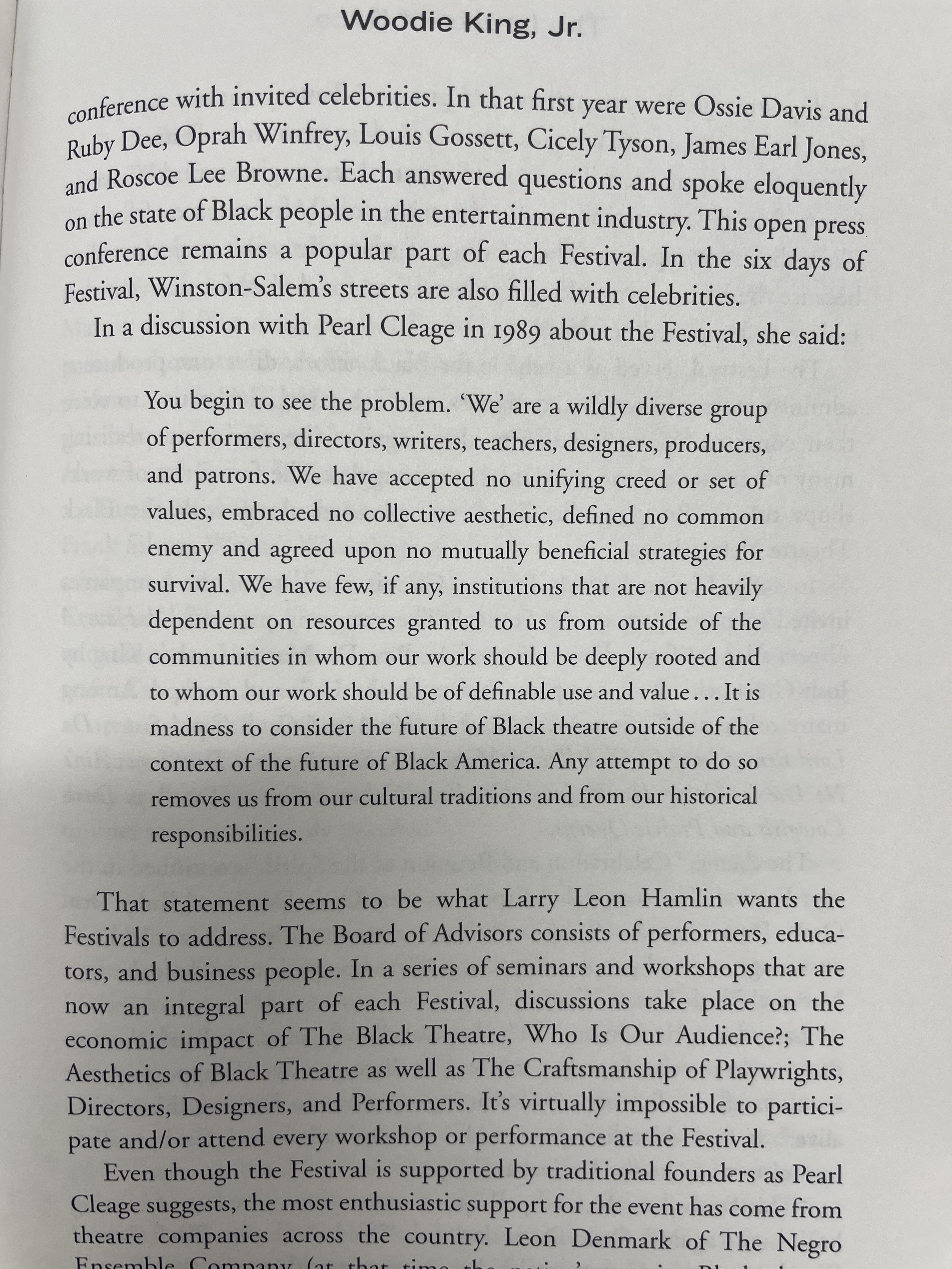
You begin to see the problem. ‘We’ are a wildly diverse group of performers, directors, writers, teachers, designers, producers, and patrons. We have accepted in no unifying creed o r set of values, embraced no collective aesthetic, defined no common enemy and agreed upon no mutually beneficial strategies for survival. We have few, if any, institutions that are not heavily dependent on resources granted to us from outside of the communities in whom our work should be deeply rooted and to whom our work should be of definable use and value… It is madness to consider the future of Black theatre outside of the context of the future of Black America. Any attempt to do so removes us from our cultural traditions and from our historical responsibilities.” p 165
more words on access/building an accessible theatre:
“A theatergoer can feel deeply, yet if what is happening on stage makes no sense he will turn off.” p 181
“Finally, Wilson spoke of “the theatre we choose to work in is European, that it’s based on the Greek theatre designed by Aristotle. We choose to adjust and change it … the American theatre is based on subscription, yet that subscription keeps Blacks out of the American theatre…. they (subscriptions) are the death of American theatre.” p 188
“In South Africa’s Black Townships there are no theatres. Performances take place in community halls, churches, cinemas, and school classrooms, venues which don’t provide facilities nor the conditions necessary for professional performances.” p 193
“A traditional African theatre audience is an active, vocal and participating component of a performance event. Such an audience is often labeled as “noisy” especially by critics who aren’t familiar with African and African American audiences. The African and the African American audience is an integral part of the performance and functions on three simultaneous capacities as spectators, performers, and critics.” p 196
“When asked back them: What does your audience come looking for? Artistic Director Douglas Turner Ward replied, “I find the Black audience doesn’t come with any pre—conception.. They probably were told that there was a play which had something to do with them and one that they could afford. Our highest ticket is $4.95. And we have some preview tickets for only one dollar. We’ve done everything to get the audience we want. One way is to give group rates and to do radio advertising. The Negro Ensemble Company consciously seeks participation of Black audiences.” p 199
an interview to keep digging:
https://www.americantheatre.org/2021/07/09/woodie-king-jr-and-a-lifetime-of-creation/