
On: ‘Invitation to the Party: Building Bridges to the Arts, Culture and Community’ by Donna Walker-Kuhne
I finished reading ‘Invitation to the Party: Building Bridges to the Arts, Culture and Community’ by Donna Walker-Kuhne in April.
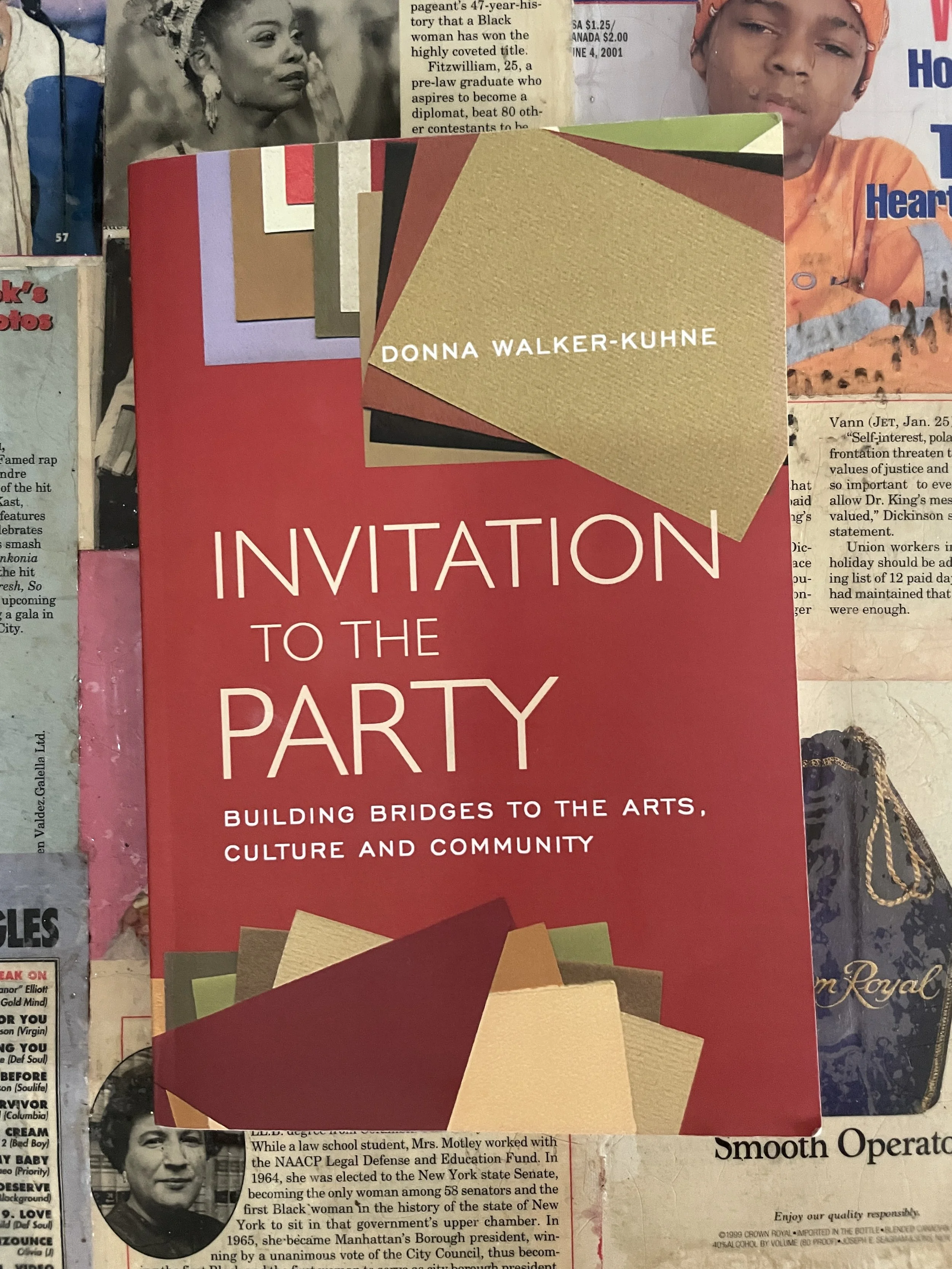
For five years I’ve been working to develop an audience for The Black Drama School with very little guidance. Most of what I’ve read this year has been in preparation for The Black Drama School’s expansion and introduction of digital programming in the Fall. ‘Invitation to the Party’ felt like a natural progression in my research on Black theatrical production and programming legacies, following my completion of Woodie King Jr.’s ‘Impact of Race: Theatre & Culture.’ As I study the strategies for community engagement and audience development utilized by Woodie King Jr. and Donna Walker-Kuhne, I attempt to implement these methods in my work with The Black Drama School.
Walker-Kuhne’s strategies for building audiences center cultural awareness, dedication, and genuine community connection.
“An effective audience development initiative begins with a vision— a dream— a plan. The more specific and detailed the blueprint you create, the more effective you are going to be. Take a minute and think about this: What is your vision? Is it personal or institutional? What do you need to make it happen? With whom do you share this vision?” (p 4)
“The most important component of audience development is the spirit of collaboration among every department of the arts institution— a willingness to invest the time, labor and resources needed to be successful.” (p 5)
“Audience development requires a strategic plan that is holistically integrated into the fabric of your arts institution. The strategic plan must be grounded in the history of the institution, as well as the history of the audiences you are seeking to attract.” (p7)
When I consider the history of the The Black Drama School, I consider the history of Black theatre in nontraditional spaces:
The footwork Zora Neale Hurston undertook through rural parts of Florida to share Langston Hughes’ writing in the 1930s.
The American Negro Theatre in the basement of the 135th Street Branch Library in New York in the 1940s.
The coffee house and bar stages of the Black Theatre Movement of the 1960s.
My vision considers the ways in which Black dramatists have worked to make room for theatre— and how community immersion, collaboration and care act as pathways to access.
“Audience development is the merging of marketing techniques with relationship-building skills, because in order to have a lasting impact on your prospective audience, the relationship must be both personal and institutional.” (p 11)
I heard/read/saw somewhere “to be loved is to be known.” Audience development requires a certain level of vulnerability— an openness/willingness to connect with others who very well may not want to connect with you.
Sometimes it do feel like begging, ngl.
It has been helpful for me to remember that a person’s reaction to me is rarely actually about me, and that everyone is busy.
Everyone is busy.
10 TOOLS FOR BUILDING AUDIENCES
💟
10 TOOLS FOR BUILDING AUDIENCES 💟
10 TOOLS FOR BUILDING AUDIENCES
(p 23)
investment
“Do not expect results tomorrow, next week or even next month. You are informing a new constituency about your product, you are striving to develop relationships, and you are developing ways for these future arts consumers to become comfortable with accessing what it is you have to offer. This takes time.” (p 24)
So much of what I learned in this text felt like life lessons. You need to have patience to see it through.
commitment
“This means going beyond the normal workday. It means extending your life to support their goals, recognizing that this is an opportunity to build trust.” (p 25)
research: who is the audience?
“Two kinds of research are necessary: the quantitative research tells you the numbers and percentage of ticket buyers and provides statistics on other buying habits; the qualitative research speaks to how and why a particular audience member responds to a cultural product…” (p 25)
“Ask your questions from a place of sincerity, genuine interest and compassion.” (p 25)
educating your artists and audiences: demystifying the art product
“Educating your audience means helping them understand the importance of connecting their lives to your product.” (p 27)
review and analysis
follow-up
partnership
building the bridge/extending the invitation
creating value
appreciation: “thank you” is the world’s most powerful phrase.
“If you build bridges, they will come.” (p 32)
The book is filled with anecdotes from Walker-Kuhne’s experiences in the field working in collaboration with many notable arts institutions across New York. It is really interesting to see how the organizations she has worked with have grown and how her work has impacted the way the institutions engage with audiences today.
I got my first car junior year of high school and I put bumper stickers on the back bumper (art school), and among those bumper stickers was a Frederick Douglass quote: “If there is no struggle, there is no progress.”
On page 57, the chapter page for Chapter 5 entitled, ‘Cultural Explosions: The Public Theater,’ the words greeted me again. I’ve been searching for them, but I hadn’t seen them in a long time.
It felt like a reminder that the work to which I’ve chosen to dedicate myself, will not be easy.
But also that it can be done, and that it is worth it to see it through.