
Clyde's
Lynn Nottage’s Mud, River, Stone is one of my favorite plays. to me, it is her best work.
so naturally I was excited to have the opportunity to see Clyde’s, Nottage’s newest work that seemed to meld a lot of the things I’m passionate about: food, prison abolition, theatre. I felt really lucky — the play was offered as a simulcast with thirty dollar tickets for patrons under thirty.
in my pre-show research, I read a review by Vinson Cunningham for The New Yorker entitled ‘The Search for Justification in ‘Clyde’s’ and ‘Trouble in Mind’.’ in the essay, Cunningham discusses the depth of the roles Uzo Aduba typically portrays and the lack of this depth in the character Clyde.
and Cunningham is not wrong.
though Aduba’s face is plastered everywhere as branding for Clyde’s, the play is not about Clyde. the play seems instead to subtly focus on Jason, a character from Nottage’s previous play, Sweat. and Nottage does this in a really beautiful way using dialogue and situational comedy to highlight Jason’s plight.
but Jason is a yt man and Aduba is a Black woman and it seems a little backwards to market a play about a yt man with a Black woman’s face.
in addition, after conducting my own research about formerly incarcerated people and the food service industry I felt really frustrated by the crass jokes, borderline sexual harassment and financial abuse Clyde inflicted on her employees. I get that the play is a comedy and like teehee I guess but I don’t think Clyde’s vilification was necessary for the play to be funny. there are so many programs for formerly incarcerated people in restaurants and the context of these people from different backgrounds being in a kitchen together is enough for natural comedy to ensue.
it’s definitely one of those shows that’s performed like it’s onstage.
the tone of the play shifts quickly from moment to moment as the characters experience very high highs and very low lows.
and the characters felt like caricatures— everyone was kind of the backdrop for Jason’s story.
Jason, covered in yt nationalist tattoos who “doesn’t believe in that stuff” anymore.
and that whole thing is exhausting too because at one point Letitia (another employee at Clyde’s) says that prison acts as a great equalizer and it *literally* doesn’t if yt nationalist tattoos are considered a survival tool for yt men. does that not imply that a racist hierarchy exists in that space???
when it was about the food, the play was a bit more bearable. I appreciated the discussions about dream sandwiches and even the premise of working at a truck stop. and I liked that food news outlets were covering a play about food. that was really cool.
but overall and in general, this was a frustrating watch.
the scholarship was missing.
nobody did the reading.
and it makes me question the validity of being your own dramaturg. not everyone is gonna do the research it takes to make something true and authentic, so how do we verify that each playwright working without a dramaturg knows how to do this? what strategies or structures should be introduced that guide or govern research to make sure that playwrights don’t miss vital information that could transform their work for the better?
'SEMBLANCE'
though many arts institutions relying on the financial exploitation of their patrons will disagree, the coronavirus pandemic is far from over. as of September 2021, I am not ready to return to in-person theatre and the surging covid rates in my area confirm each day that I am making the right decision.
it’s not an easy decision to make, especially as someone whose profession seems to rely on the existence of these ‘live’ shows. as major arts institutions return to hosting their annual outdoor festivals and Broadway prepares to open it’s doors, accessible programming has dwindled. many theaters are shutting down their digital and low cost programming to make way for the return of their in-person events. and though the lack of regard theaters have for their performers, practitioners and audiences is generally repulsive, the fulfillment of this lack is one of the many reasons Whitney White’s SEMBLANCE at New York Theatre Workshop is so special.
SEMBLANCE is not theatre and it doesn’t claim to be. NYTW’s website refers to this production as “a filmed theatrical experience.”
so, again to be clear, SEMBLANCE is a film, and like all film, it’s foundation is theatre.
when SEMBLANCE opened at New York Theatre Workshop, patrons had the opportunity to enjoy the piece true to theatre’s communal form in NYTW’s newly renovated reduced seating performance space. NYTW’s website rightfully boasts of physically distanced seating through the use of ‘social distance bubbles’ while implementing a strict entry policy. after its in-person run, SEMBLANCE moved to streaming where it can currently be enjoyed for $10 until October 24, 2021. and while NYTW seems to be boldly committing to digital, accessible programming with the production of SEMBLANCE, I do wonder how NYTW will sustain it’s commitment to accessibility after this production.
through a series of monologues that break the fourth wall, SEMBLANCE pushes viewers to confront their biases toward Black women. it is a one person show featuring actress Nikiya Mathis who portrays an ensemble of characters known as ‘The Women.’
it is a bit difficult to talk about ‘The Women’ as individual character names (or means of identification) are not made known to the audience. I completely understand the artistic choice White makes in doing this, but I think that identifying each of these characters as individual units would result in deeper, more specific discussions around the piece.
SEMBLANCE provides the audience with irrefutable evidence of the havoc capitalism wreaks on the life of the Black woman. White offers Black women in various stages of labor: working at Sweet Green, waiting for a manicure, taking care of someone else’s child, preparing for a speech, etc. the message is clear: Black women labor, and the expectation of this labor hinders their ability to rest.
within this discussion of capitalism, White reminds her audiences that Black women should not have to earn the right to rest.
“I will not dream of labor”
in a scene at a nail shop, a Black woman is deemed undeserving of her manicure because of the time of day she is receiving it. with a little digging (digging that I’m almost certain other audience members won’t do), I found that this woman is also referred to as ‘Young Mother.’ the assumption is that this woman should be at work, and because she is not at work, she shouldn’t be getting her nails done.
I am all too familiar with the sensation of the white gaze in these spaces of leisure.
on those rare occasions in which I have gone to get my nails done after 1 PM it is almost always busy and the white lady beside me is always listening a little too intently, happy to chime in though her conversation was never invited. there’s the comments about the color I chose, the length— I am forced into conversation and must labor in my time of rest.
only two characters in White’s piece find the space to rest, and both are required to labor through that space. ‘Young Mother’ is one of these two women. during the scene at the nail shop, ‘Young Mother’ accosts the audience for suggesting that she doesn’t deserve to rest. she doesn’t get to enjoy her manicure/she doesn’t get to relax/she has to spend her leisure time explaining herself. the irony in this scene leaves little room for misinterpretation: ‘Young Mother’ explains why she shouldn’t have to explain herself, and she shouldn’t even have to do that. it’s a poignant example of how internalized and implicit capitalism can keep Black women from rest.
realistically, I nor ‘Young Mother’ want to have these conversations but the people we’re having them with expect them from us and react poorly when we don’t engage.
when people expect Black women to labor, they often rob them of rest in ways that are subconscious.
let that simmer for a bit.
most of ‘The Women’ are working themselves to death and for me, a Black woman, it’s a bit scary. it’s sad to see so many Black women dying in this production even if that death is implicit. White’s characters acknowledge this sadness often reflecting it, but little is done to provide care for Black women viewing the piece. with the exception of one scene there is very little explicit joy or pleasure in this production and because of this lack, I question whether the show is intended for audiences of Black women.
SEMBLANCE does, however, encourage the exploration of processes that directly serve Black women. it would be impossible for Mathis to play the roles of ‘The Women’ — of Black women — without bringing herself to the character. in an essay for Backstage.com, Mathis writes that she presented herself in all the different roles that she portrayed, “approaching them in [her] body.” in the final scene of the play, Mathis removes her makeup and makes eye contact with the viewer, first indirectly by looking into a mirror, then directly by turning around and facing the camera. allowing the audience to experience these final moments with Mathis reasserts the humanity of the Black woman, and gives the Black woman further confirmation that she can be and often is, all of these women at once.
I would LOVE to see more programming for this show that gives Black women a space to process what they’ve seen and figure out how to move forward in life leading with radical, unapologetic rest.
experience SEMBLANCE at NYTW until October 24, 2021
and let me know what you think.
'SHADOW/LAND': a study guide
SURPRISE! I was going to write a critique for Erika Dickerson-Despenza’s SHADOW/LAND but I wanted to make a study guide instead. as I listened to SHADOW/LAND and it’s related offerings, Christina Sharpe’s ‘In the Wake: On Blackness and Being’ kept coming up.
in this study guide, we’re considering SHADOW/LAND through the lens of ‘the wake.’
listen to Erika Dickerson-Despenza’s SHADOW/LAND
and let me know what you think.
'Bernarda's Daughters'
I think it’s safe to say I hate theatre on Zoom. even more than that, I hate the idea of paying $35 to watch a filmed theatre production on my laptop.
and who standardized the price of these virtual productions anyway? do they care that people are out of work? do they realize that pay-what-you-can pricing exists? and if we’re paying what we can, how did a $15 minimum come about?
it’s time for theatre to take a new shape. to shift into something that fits where we are right now without reverting to the radio play, succumbing to Zoom, or simply filming staged performances. theatre has to escape the traditional/the known/the norm, and it is up to all theatre artists — actors, directors, playwrights, designers — to figure out where theatre goes from here.
I follow Diane Exavier on Twitter.
I remember seeing her tweet about ‘Hotline Sing’ and thinking “this is brilliant. I hope I don’t miss this.”
‘Hotline Sing’ is one of the many experiences and iterations of her play Bernarda’s Daughters, a piece that she describes as being in conversation with Federico Garcia Lorca’s The House of Bernarda Alba and Sylvia Wynter’s The House and Land of Mrs.Alba.
Lorca’s The House of Bernarda Alba is in an anthology of Lorca plays that I swiped from my middle school’s black box theatre. (forgive me) I hadn’t read it prior to delving into the experiences Exavier created for Bernarda’s Daughters, but I did dig it out of a box in my closet to read before I wrote this critique.
and while reading Lorca’s piece provided some insight as to what Exavier’s play might be about, reading it was not a requirement. even with a lack of knowledge in regards to Exavier’s reference works, one could still be transported into the world of the Abellard sisters with ease. the website Exavier has constructed for the play, bernardasdaughters.club, allows audiences to journey into the world of the play and the lives of the Abellard sisters without the traditional limitations of physical theatre.
there are essays, poems, a history of iterations of the play, digital experiences, and a library full of recommended texts and podcasts.
the experience of Bernarda’s Daughters is special for many reasons.
we don’t have to do it at the same time.
we don’t have to be in the same place.
and we don’t have to spend an exorbitant amount of money on tickets.
we can go to this website and traverse into this world.
I started on the home page, and then explored the different iterations of this work.
Exavier does something that I’ve always wanted to do with theatre, and that is putting it in a gallery space alongside visual artists. in 2018, Exavier’s work took the shape of a piece entitled ‘Hold(ing) Tight,’ displaying seven postcards that made up the fifth act of her play as a part of an exhibit entitled ‘The Final Act’ in the Woskob Family Gallery at Penn State. her next iterations would include workshops and essays and eventually, a reading.
I took the time to click through each of these links, all of which can be found on the play’s website, and even read an interview that was conducted while Exavier developed her play at The Lark.
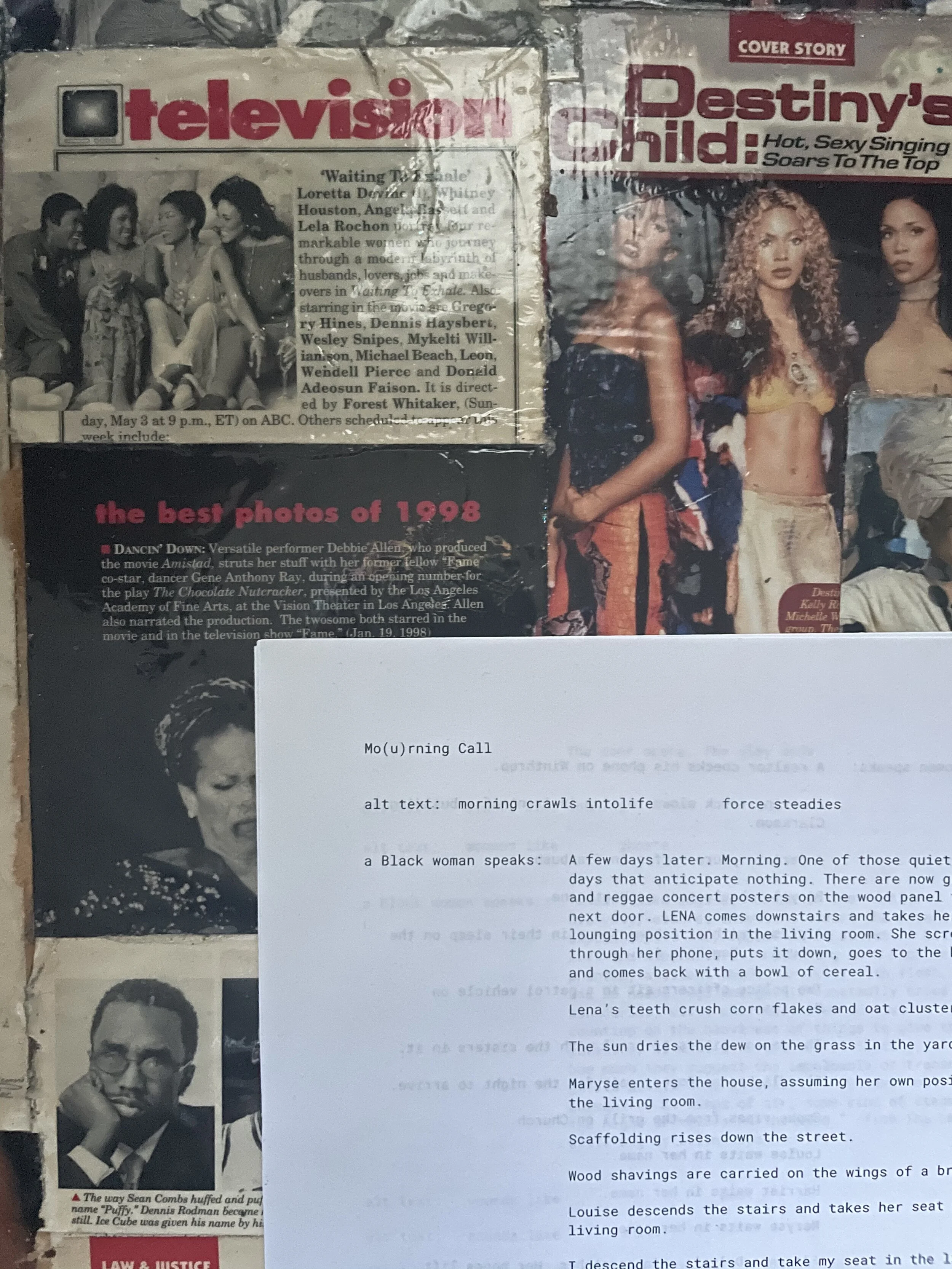
I did all of this before reading/watching ‘Mo(u)rning Call’ which is perhaps Exavier’s most traditional theatrical offering that is currently available.
‘Mo(u)rning Call’ is a video, a little less than thirty minutes, that consists of sights, sounds, and words. though it is reminiscent of an audio play, the visuals and transcript provided aid in taking the audience even further into the realm of the play.
in Exavier’s interview at The Lark, she gushes over poets and the act/practice of poetry. her love for poetry is clear in her writing as ‘Mo(u)rning Call’ sounds ethereal, almost like the words and sounds are floating.
I’ve spoken before about how I am tired of seeing/hearing/ingesting Black pain but listening to Exavier’s piece helped me clarify this sentiment. I think when we as writers begin to detail the Black experience it becomes difficult to leave out such an integral part of our lives. the task is to shift the focus. Black people are allowed to struggle, to feel pain, but our experiences are not limited to pain. when I think about my everyday life, I’d be remiss to leave out the painful parts/that wouldn’t be real, that wouldn’t be authentic. if you’re writing stories about Black life, you have to acknowledge Blackness, and sometimes being Black hurts.
I ended my time with the Abellard sisters by calling ‘Hotline Sing.’ and though this iteration is similar to ‘Mo(u)rning Call’ in that it is auditory, it is the audience’s ability to dictate what they want to hear and who they want to hear from that really elevates ‘Hotline Sing’ into something completely different.
when you consider all of Exavier’s iterations of Bernarda’s Daughters there is an experience created outside of the theatre that draws the audience in, immersing them in the lives and landscapes of the Abellard sisters without the traditional performance of a play, and in a much more engaging, communal way than pre-recorded theatre.
and maybe that’s what we should be leaning towards as theatre artists.
how can we create the world of the play without the physical space of a theatre? how can we take our audiences out of their homes without them having to leave? and what does it take to make characters and spaces exist without their physical embodiment?
I haven’t seen Bernarda’s Daughters, but I know their world, and each of them, exist.
experience Bernarda’s Daughters here.
and let me know what you think.